
Dhinwa Construction — Mega Menu v2
5th Floor, Sunny Mart, Mansarovar, Jaipur
Factory Construction Company in Jaipur, Rajasthan | Dhinwa Construction
Service Page · Industrial & Infrastructure

Factory Construction Company
in Jaipur, Rajasthan

Industrial buildings are not general construction. The floor carries machines that weigh tens of tonnes. The structure must be column-free where production lines run. The power infrastructure must match equipment load specifications from day one. Get any of it wrong, and the building cannot be used for what it was built to do.

Turnkey (EPC) Design & Build Civil & Structure Industrial Fit-Out RIICO Zone Compliance Phased Delivery
35L+ Sq. Ft. Delivered Portfolio
ISO ×3 Quality · Safety · Environment
0 Abandoned Projects — Ever
7 Yrs Jaipur, Est. 2018
What Industrial Construction Actually Requires

A Factory Owner Is Not a Developer.
They Are an Operator With a Production Schedule.

A real estate developer can absorb a delayed tower — they move the possession dates and manage the commercial consequence. A factory owner cannot absorb a delayed building. Their equipment has already been ordered. Their workforce has already been hired. Their customers already have a first-delivery commitment. Every week the building is not ready is a week of production revenue that does not exist — and cannot be recovered.

That is the pressure that industrial construction sits under. It is not about building a structure — it is about handing over a production-ready environment by a date that is already printed somewhere on a business plan.

The equipment arrives on a specific date. The building must be ready before that date — floors cured and load-rated, power infrastructure commissioned and tested, drainage operational, clearances in hand. Dhinwa programmes factory projects backwards from the equipment installation date, not forwards from the mobilisation date.

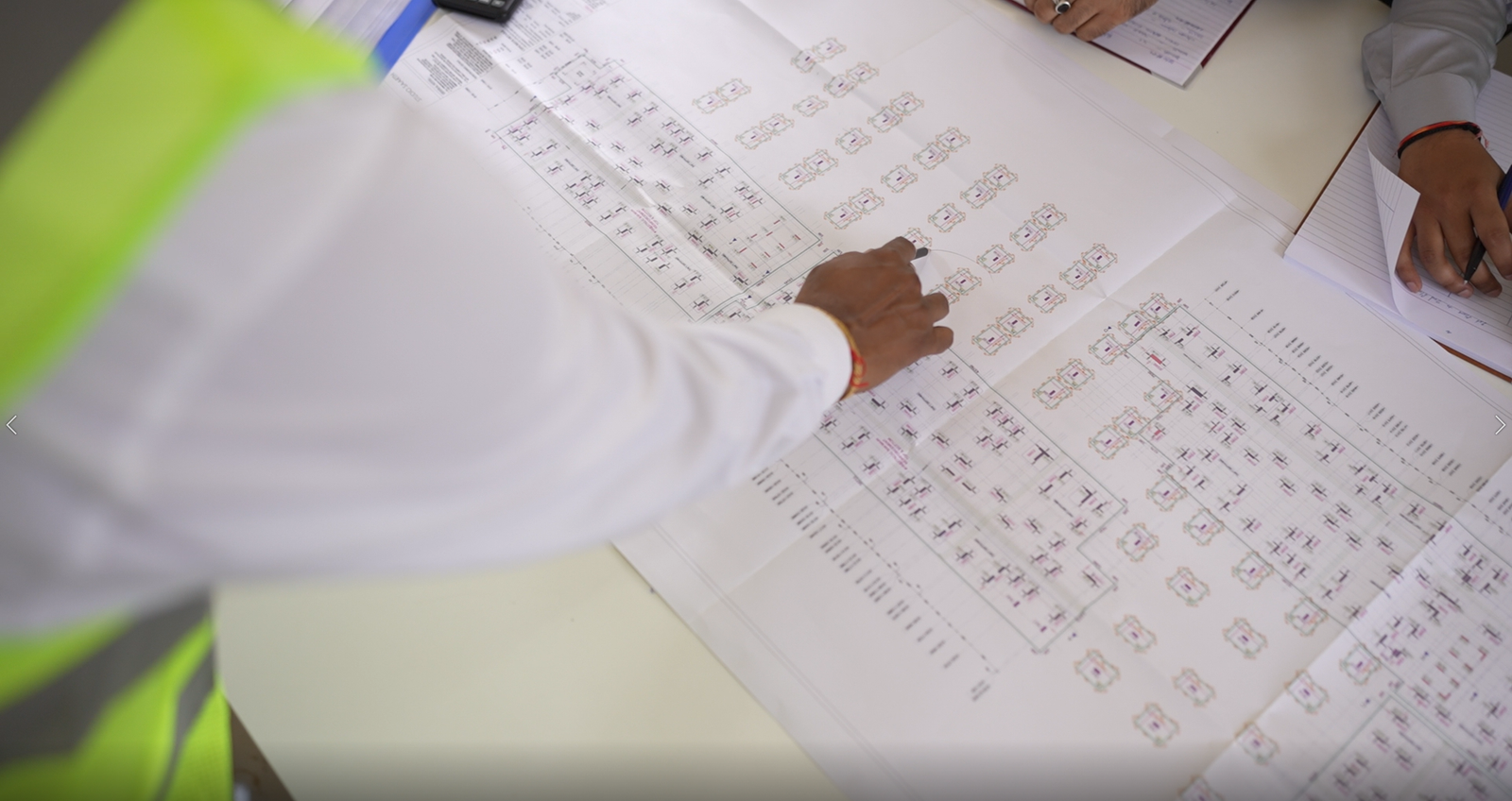
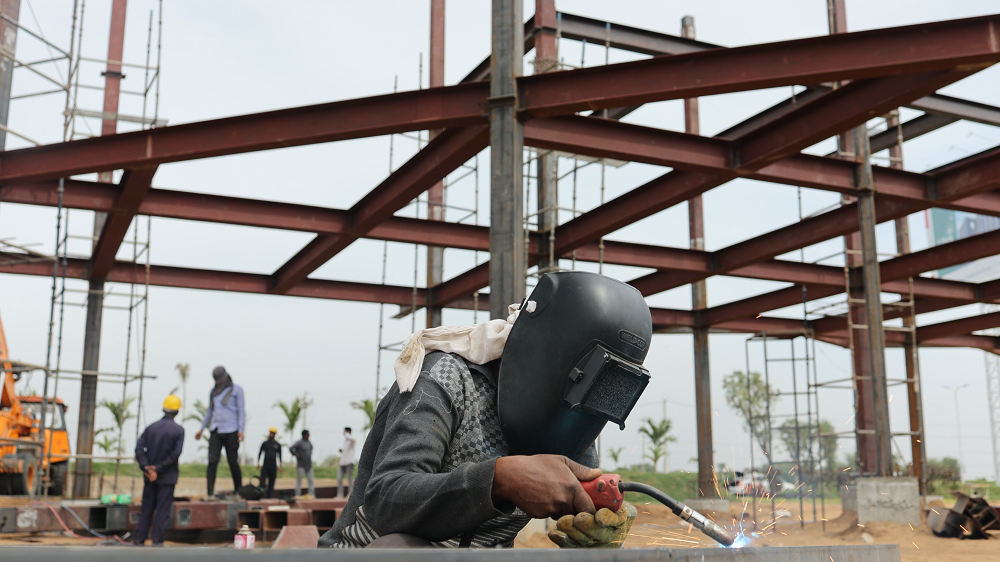
Heavy factory structural and concrete works
Industrial Construction · Heavy Load Requirements
Industrial Facility Types

Industrial Construction —
What Dhinwa Is Equipped to Build

Rajasthan's industrial corridor — Jaipur, Neemrana, Bhiwadi, Sitapura — spans manufacturing, warehousing, processing, and light-to-heavy industrial facilities. Each type has a different structural brief.

01
Manufacturing Plants & Factories
Production floor structures designed around equipment loads, column-free spans for production lines, and material flow logic from raw material entry to finished goods dispatch.
02
Warehouses & Logistics Facilities
Large-span storage structures with racking load provisions, dock-leveller bays, high-bay lighting infrastructure, and fire-suppression systems for stored goods classifications.
03
Food Processing & Cold Chain Facilities
Processing buildings with industrial hygiene-grade floor finishes, HACCP-compatible drainage systems, cold room structural provisions, and condensation management in wall and roof design.
04
Light Industrial & Workshop Buildings
Smaller-footprint industrial structures — workshops, fabrication yards, assembly buildings — with the same structural discipline as larger plants applied at appropriate scale.
05
Industrial Campus Infrastructure
Full factory campus — production building, administrative block, utility building, guard rooms, boundary walls, hardstanding yards, internal roads, and external drainage — delivered as a single coordinated project.
06
Expansion of Operational Facilities
Addition of production bays, warehouse extensions, or utility upgrades to a live factory — sequenced so that existing production is not interrupted during construction of the new phase.
What Makes Industrial Construction Technically Distinct

Six Requirements That Do Not Exist
on Any Other Building Type

A contractor who has only built residential or commercial buildings will encounter each of these requirements on a factory project for the first time. Resolving them during construction — rather than before it — is what causes industrial projects to delay and overspend.

Heavy Floor Load Ratings
Industrial floors must be designed for the specific point loads and distributed loads of the equipment that will sit on them. An M25 standard industrial floor slab is not the same as a slab designed for a 20-tonne CNC machine. Floor thickness, reinforcement, joint spacing, and curing time must be designed per the equipment schedule before structural design is issued.
Column-Free Clear Spans
Production lines, racking systems, and material-handling equipment require column-free spans that standard RCC frames cannot achieve at economical cost. Industrial structures typically use pre-engineered building (PEB) frames or long-span roof trusses to achieve these spans. The structural system must be decided and engineered before civil foundation work begins.
Heavy Power Infrastructure
Industrial facilities run on high-voltage power — often 11kV or 33kV incoming supply, with transformer yards, switchgear rooms, and dedicated feeder circuits to each machine. The electrical infrastructure for a factory is not a finishing-stage decision. Switchgear room sizing, cable trenches, and HT cable provisions must be designed into the civil structure from the start.
Industrial Drainage & Effluent
Manufacturing processes generate process water, cutting fluids, wash-down water, and effluent that must be captured and disposed of per RSPCB norms. Industrial drainage is not domestic drainage at larger scale. Floor gradients, trench sizes, interceptor tanks, and ETP connections must be coordinated with the production process design before floors are laid.
Overhead Material Handling
Factories with overhead cranes — EOT cranes, jib cranes, monorails — require structural provisions that must be built into the building frame: crane runway beam supports, column brackets, and foundation designs sized for dynamic crane loads. A building frame that was not designed for a crane cannot have one added later without structural intervention.
RIICO & Industrial Zone Clearances
Industrial construction in Rajasthan's designated industrial areas — Sitapura, Vishwakarma, Mahindra SEZ, Neemrana — requires clearances from RIICO, RSPCB, fire authority, and Pollution Control Board before construction can begin. The approval sequence must be mapped before mobilisation, because building without clearances cannot be regularised easily.
How Dhinwa Executes Industrial Projects

Built Around the Equipment Schedule.
Not Around the Contractor's Convenience.

Every decision in industrial construction — from the structural system to the floor specification to the power infrastructure — exists to serve one outcome: a building that is ready to receive its equipment and begin production on the owner's schedule.
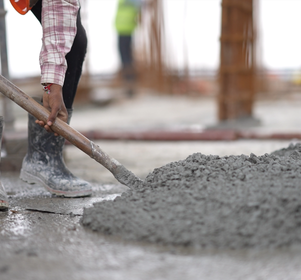
Heavy equipment installation ready floor
Production Date — Fixed
01
Equipment Schedule as Programme Anchor

The factory owner's equipment delivery date is the fixed constraint. Dhinwa begins every industrial project by confirming that date and programming backwards: when must floors be complete and cured to accept equipment loads, when must power infrastructure be commissioned and tested, when must the building be handed over with all clearances in hand. Construction planning serves the production schedule — not the other way around.

02
Equipment Load Coordination

Before any structural design is finalised, Dhinwa obtains the equipment schedule from the owner — machine types, weights, footprints, foundation requirements, and utility connections. The structural engineer designs the floor slab, foundations, and frame around these loads. The electrical engineer sizes circuits per the connected load list. Discovering mid-build that a slab is under-designed for a machine is a planning failure we avoid upfront.

03
Industrial Floor Specification & Execution

Industrial floors must be flat to tight tolerances for racking, load-rated to the equipment schedule, finished to the appropriate surface specification (hardener, epoxy coating, or standard OPC), and cured for the full specified period before any loaded access. Dhinwa's floor execution follows the specification without compression — because a failing floor cannot be repaired without halting operations.

04
RIICO & Regulatory Clearance Tracking

Industrial construction involves multiple regulatory authorities — RIICO for building plans, RSPCB for consent to establish, fire authority for NOC, and factory inspector registration. Dhinwa tracks each clearance as a programme milestone — applications submitted at the right stage of construction, not after completion when the production launch is already at risk. The owner should not be managing regulatory timelines.

05
Expansion on Live Industrial Sites

Expansion of a factory in operation requires construction logistics that protect production continuity. Vibration from piling must be managed adjacent to precision manufacturing. Dust must be contained away from clean environments. Utility interruptions must be scheduled during planned production shutdowns. Dhinwa plans live-factory construction logistics before mobilisation.
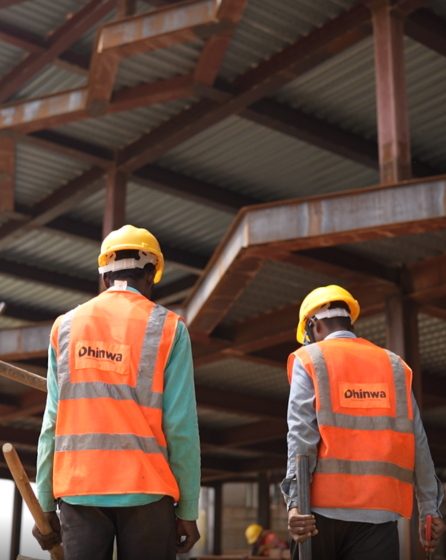
PEB Structure factory construction process
6 Phases
Delivery Process

How a Dhinwa Factory Project
Is Delivered on the Production Schedule

Six stages. The equipment installation date is confirmed in Stage 1 and governs every stage that follows.

01
Industrial Brief & Equipment Schedule Confirmation
Project brief established with the factory owner. Equipment schedule obtained — machine types, weights, foundation requirements, utility connections, and delivery dates. RIICO zone and applicable regulatory framework identified. Equipment installation date confirmed as the programme's non-negotiable end point.
02
Structural System Selection & Design Coordination
Structural system selected for the required spans and loads — RCC frame, PEB, or hybrid. Floor slab designed to the equipment load schedule. Crane runway provisions engineered into the frame. Electrical infrastructure sized to the connected load list. Drainage and effluent system designed to the production process.
03
Regulatory Clearances — Initiated During Design
RIICO building plan approval, RSPCB consent to establish, and fire NOC applications initiated during the design phase. Clearance timelines mapped against the construction programme. Construction sequenced to begin on components that do not require clearance while approvals are in process.
04
Civil Foundation & Structural Execution
Equipment foundations poured to the specified load before the superstructure begins. RCC or PEB frame erected. Industrial floor cast, jointed, and finished to specification — then cured for the full specified period before loaded access. Utility trenches and service routes built in as the structure proceeds.
05
Power Infrastructure, Drainage & Services Commissioning
HT/LT electrical infrastructure installed and tested zone by zone. Industrial drainage commissioned and flow-tested before floors are finished. Compressed air and process gas lines installed and tested. Overhead crane installation coordinated. Systems commissioned against the specification with test documentation.
06
Production-Ready Handover
All clearances in hand — factory inspector registration, fire NOC, RSPCB consent, RIICO completion certificate. Equipment foundations verified. Power infrastructure certified. The owner receives a building ready to accept equipment installation and begin production immediately.
Industrial Track Record

Industrial & Infrastructure
Projects Delivered in Rajasthan

Dhinwa's industrial project portfolio is active within Rajasthan's key industrial zones. We deliver heavy structural builds at the scale required for robust manufacturing operations.

Large commercial and industrial complex construction
Commercial Complex
Jaipur, Rajasthan
Large-scale commercial infrastructure project — structural execution, civil works, and building services delivered as a complete project. Demonstrates Dhinwa's capability in large-footprint non-residential construction at the scale relevant to industrial facility clients.
Delivered
Clear span structural execution
Sports Complex
Rajasthan
Large-span structural build — demonstrates the clear-span execution capability directly relevant to industrial production floor structures. Executed to strict timelines and heavy load specifications.
Delivered
Industrial Projects — Portfolio
Factories and manufacturing facilities listed in Dhinwa's active portfolio. Specific project details, including floor loads, PEB spans, and RIICO compliance workflows, are available on request during a project discussion.
Available on Request

Industrial clients evaluate a contractor differently from developers. They want to know: have you managed floor loads for heavy equipment, have you dealt with RIICO clearances, have you handed over a production-ready building before. These are the questions we are ready to answer in a direct conversation.

From a Client Who Evaluated the Work Directly

What Mr. Vikram Agarwal
of OM Manglam Says

Mr. Agarwal evaluated Dhinwa as a vendor — which is how industrial and commercial clients approach a contractor relationship. His assessment focuses on three qualities that matter in an industrial context above all others.

"

We've worked with many firms, but Dhinwa Construction and Engineering stands apart. Their clarity, integrity, and mutual respect make them a vendor's ideal client — consistent, fair, and committed.

Mr. Vikram Agarwal
Founder, OM Manglam — Jaipur, Rajasthan

Clarity. Integrity. Consistency. In an industrial project where the contractor is responsible for a building that must work on a specific date, these are not soft qualities — they are the three things that determine whether the production launch happens or not.
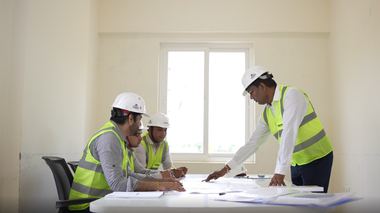
Industrial site vendor review
Certifications & Registrations

Independently Certified.
Directly Applicable to Industrial Construction.

ISO 14001 environmental management is directly relevant to industrial construction — particularly for facilities in Rajasthan's RIICO zones where RSPCB consent to establish requires evidence of environmental management systems. ISO 45001 safety management applies with particular force on industrial sites where heavy equipment, lifting operations, and high-voltage electrical work run simultaneously.

ISO 9001 Quality Management · 2015
ISO 45001 Safety Management · 2018
ISO 14001 Environment · 2015
Class AA RHB Contractor · Rajasthan
Frequently Asked Questions

Factory Construction in Jaipur —
What Manufacturers Actually Ask

Eight precise questions from industrial operators, answered directly.
Manufacturing plant floor ready for equipment
Q Does Dhinwa understand industrial floor loading requirements for heavy manufacturing equipment?
Yes. Industrial floor slabs must be designed to the specific point loads and distributed loads of the equipment that will sit on them — which requires the equipment schedule to be confirmed before the structural design is issued. We obtain the equipment list, coordinate with the structural engineer, and design the floor to the load specification. Standard construction practice does not work on industrial floors.
Q Can you build column-free spans for production lines or warehouse racking systems?
Yes. Achieving the column-free spans that production operations require typically involves pre-engineered building (PEB) frames or long-span roof trusses rather than standard RCC construction. We select and coordinate the structural system based on the span requirements and load conditions at the design stage — not after the frame is up and the production planner realises columns are in the wrong place.
Q How do you handle RIICO approvals and RSPCB clearances for factory construction in Jaipur?
RIICO building plan approval, RSPCB consent to establish, and fire NOC applications are initiated during the design phase and tracked as programme milestones — not applied for after construction is complete. We map the regulatory approval timeline against the construction programme so clearances arrive when they are needed, not after the building is finished and the owner is waiting for permissions to operate.
Q What provisions do you make for overhead crane installation in a factory building?
Buildings that will have EOT cranes, jib cranes, or monorail systems require structural provisions — crane runway beam supports, column brackets, and foundation designs sized for dynamic crane loads — that must be engineered into the building frame before construction begins. These provisions cannot be added to a completed building without structural intervention. Crane requirements are confirmed in the design brief and engineered in from the start.
Q Can you expand an existing factory while keeping production running?
Yes — but it requires site logistics that protect existing production from construction disruption. Vibration from piling or demolition work must be managed adjacent to precision processes. Utility interruptions must be scheduled during planned shutdowns. Dust containment must prevent contamination of production environments. We plan live-factory construction logistics with the factory's production team before mobilisation, not reactively during construction.
Q How do you ensure the building is ready before our equipment delivery date?
The equipment delivery and installation date is set as the programme's fixed end point on day one. We programme backwards from that date: when floors must be cured and load-ready, when power infrastructure must be commissioned and tested, when all clearances must be in hand. Weekly look-ahead scheduling tracks against this anchor throughout construction. If something falls behind, it is flagged and recovered before it threatens the equipment delivery date — not reported after it has already passed.
Q What industrial drainage and effluent treatment provisions do you include in factory construction?
Industrial drainage is designed to the production process — floor gradients, drain trench sizes, interceptor tank locations, and ETP connections are specified before floors are laid. For facilities requiring RSPCB consent, the effluent treatment design is coordinated with the regulatory submission. Drainage provisions that are inadequate for the production process cannot be corrected after floors are finished.
Q What is the minimum project scale you work on for factory construction?
We work on industrial projects above 1,00,000 sq. ft. built-up area. Smaller industrial structures within a larger campus development — utility buildings, guard facilities, administrative blocks — can be discussed as part of an integrated project scope.

Your Equipment Has a Delivery Date.
Your Building Needs to Be Ready Before It.

Industrial construction that is not programmed to the equipment schedule always creates the same problem: a production launch that cannot happen because the building isn't ready. Send us your project brief and equipment schedule — we'll show you how we programme it so that problem doesn't arise.

ISO 9001 · ISO 45001 · ISO 14001 · RHB Class AA · RIICO Zone Experience